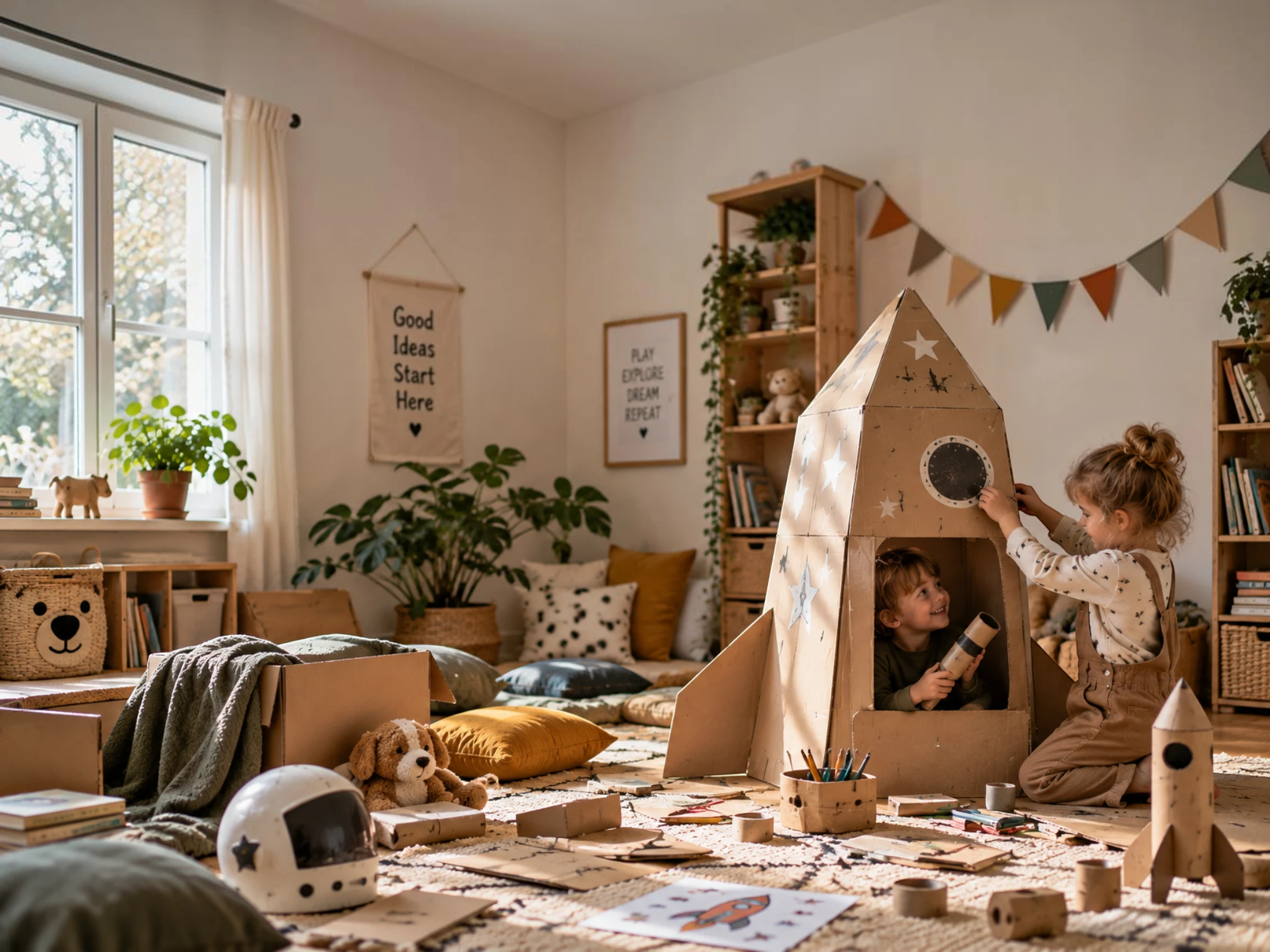
Children enjoying free play with a homemade cardboard rocket
Sleep & Evening Routine

Why Is Free Play So Important for Children?

Home » Blog » Why Is Free Play So Important for Children?

“Mum, I’m bored!”

When they hear this, many parents almost automatically start looking for a solution: we suggest a puzzle, get out some pens and paper, invent a game, plan an outing or offer another activity.

We mean well. We want our child to spend their time meaningfully, develop and simply avoid boredom. But do we really need to organise every free minute of our children’s time?

Not always.

Free play begins precisely where adults stop deciding what children should play and how they should play it. The child chooses their own activity, invents rules, changes them during play and decides when the game is over.

A simple cardboard box can suddenly become a rocket. A blanket between two chairs becomes a secret hideaway. A few cushions turn into a ship on the high seas — and a simple wooden block can be a telephone today, a car tomorrow and, a little later, food for a teddy bear.

This is what makes free play for children so valuable: the child is not given a ready-made world to act out. They create their own.

Sometimes, the best thing we can do as parents is surprisingly simple: create a safe space, give the child time and… avoid interrupting.

Why is free play so important for children?

During free play, children are not completing a task prepared by an adult. They decide what they want to play with, invent their own rules and change them when one idea suddenly develops into something entirely different.

And a remarkable amount happens in the process.

  • Creativity — children invent their own stories and discover new ways to use ordinary things.
  • Independence — they make their own decisions instead of waiting for the next instruction from an adult.
  • Problem-solving — has the tower fallen over? Will the cardboard box not stand up? Does the blanket keep slipping down? Then a new solution needs to be found.
  • Concentration — when play grows out of their own idea, children can often remain absorbed in it for a particularly long time.
  • Social skills — when playing together, children need to agree on rules, assign roles, negotiate and sometimes change their own ideas.

A wonderful example is playing “What do I want to be when I grow up?” One day, the children’s room becomes a veterinary practice; the next, a restaurant, a workshop, a research laboratory, a fire station or a spaceship.

This is where parents can do something particularly valuable: follow their child’s curiosity. If they want to be a vet today, we can explain that vets treat dogs and cats, as well as horses, farm animals and exotic animals. If the child builds a rocket, this can naturally lead to a conversation about astronauts, engineers or scientists.

The idea is not to turn play into a lesson. Adults offer an interesting prompt — and the child decides what comes of it. Sometimes, a single fascinating piece of information is enough to take the game in a completely new direction.

Children do not necessarily need lots of toys for free play, either. A cardboard box can become an ambulance, a shop counter or a spaceship. A blanket becomes an explorer’s tent. Wooden blocks turn into medicine, food for their own shop or tools in a workshop.

A ready-made toy often already defines what it is. A simple object leaves a much more exciting question open:

“What could this be?”

And that question is where a child’s imagination begins.

Movement during sleep is completely normal. A safe bed does not restrict your child — it protects them when it matters.

How can we create the right conditions for free play?

Free play does not mean that all a child needs is an empty room and the instruction “Go and play”.

The environment plays an important role. We can arrange it so that children can independently choose things, combine them and change them according to their own ideas.

Do not offer every toy at once.

When shelves and boxes are overflowing, children have a huge choice but often do not know where to start. Some toys can be put away for a few weeks and rotated later. Building blocks, figures or vehicles that have been out of sight for a while can suddenly become exciting again.

Put together an “anything box”.

It does not need to contain more ready-made toys. Materials without a fixed purpose are much more interesting: fabric scraps, cardboard tubes, small boxes, paper, masking tape, clips, string or wooden pieces. Of course, the contents should always suit the child’s age and contain no small objects that could be swallowed or other dangerous items.

Let everyday objects become part of play.

Two chairs and a blanket become a tent. A delivery box becomes a car. A bowl can be an astronaut’s helmet, and a wooden spoon can be a microphone. Not everything children play with has to come from a toy shop.

Leave some clear floor space.

This is easy to forget when furnishing a child’s room. Children need space to lay out train tracks, build a town, open a restaurant or create a hideaway. A room filled with furniture and storage boxes right into the centre may offer plenty of storage, but little room for actual play.

Do not make children tidy away every game before dinner.

If a structure is stable and does not block any walkways, it can sometimes stay until the next day. The child can then return to their idea and develop it further without having to start from scratch.

Do not correct your child’s ideas.

If a cardboard rocket has three wings, the vet treats a giraffe in the kitchen or the train travels from a chair straight under the table, it does not have to make sense to adults. Free play is not a project that needs to be assessed or improved.

And finally: Do not immediately offer a solution at the first “Mum, I’m bored!”

We can simply reply: “I understand. I’m curious to see what you come up with.”

Then give the child some time.

Our role in free play is not to invent the next activity. We create the conditions in which children can develop their own ideas.

Frequently asked questions

Does free play mean parents should not play with their child?

No. Playing together with parents is important, but free play for children works differently: the child chooses the theme, develops their own rules and decides how long they want to play. Adults can join in when invited, but should let the child lead as much as possible and leave room for their own ideas.

My child is always bored — should I suggest an activity?

Not every time. Boredom in children can be the very moment from which independent play emerges. Instead of immediately offering a new activity, a toy or a screen, it is worth giving the child some time. Often, an idea of their own develops: building, drawing, inventing pretend games or experimenting with things they find in their room.

Which toys encourage free and creative play?

Things that allow more than one way to play offer particularly many possibilities. Building blocks, figures, cardboard boxes, fabrics, paper, wooden pieces or cushions can take on a different meaning every time. This does not mean that ready-made toys are bad. What matters is leaving enough room for imagination, creativity and children’s own play ideas.

How can I arrange the children’s room so my child can play independently?

In a children’s room that supports free play, clear floor space, easily accessible toys and materials, and simple storage that the child can use independently all help. Everything does not have to be visible at once. A smaller selection can even make it easier for children to choose and start playing on their own.

Good to know

“I’m bored” does not automatically mean “Entertain me”.

When children spend some time without a ready-made activity, they have the opportunity to develop a play idea of their own. We therefore do not need to fill every quiet or boring minute with another activity.

Our recommendation

Leave room in the children’s room for toys and, above all, for playing.

An open area on the floor can be a building site today, a veterinary practice tomorrow and an airport, a shop or a base for little explorers the day after. Ideally, children should be able to reach the materials they need, combine them according to their own ideas and sometimes even leave a game set up until the next day.

This does not require a room full of toys. It requires space, accessible materials and time during which nobody dictates what to play or how to play it.

These are the conditions that support free play, creativity, imagination and a child’s growing independence.

Suitable Solutions for Your IKEA KURA Bed

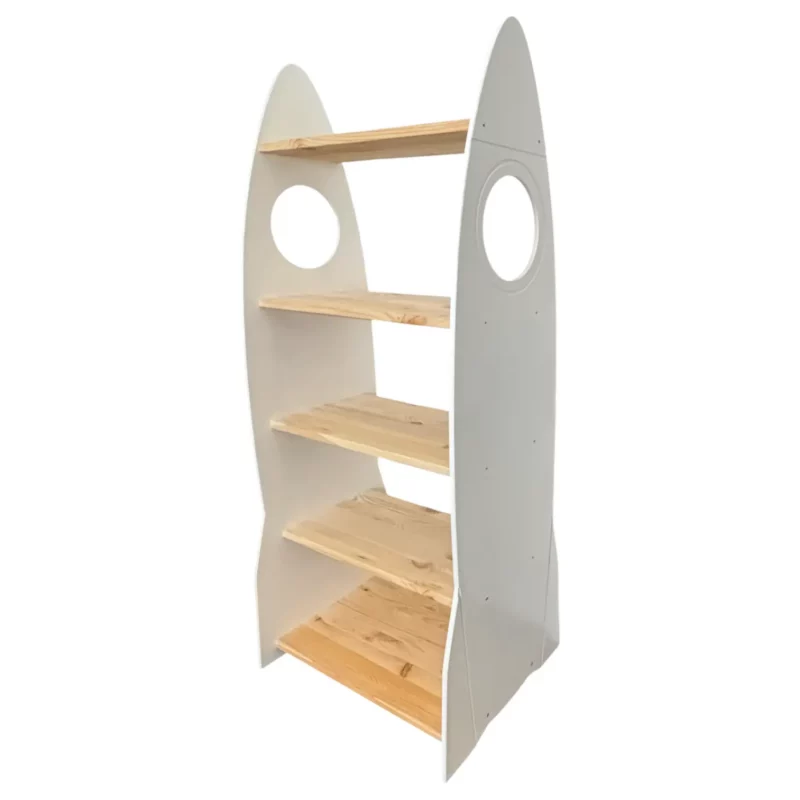
IKEA KURA Bed Rocket RAKETE Decorative Side Panel White

IKEA KURA bed rocket RAKETE decorative side panel in white

IKEA KURA Bed Montessori Shelving Unit RAKIETA MIDI White - white

IKEA KURA bed Montessori shelving unit RAKIETA MIDI in white

IKEA KURA Bed Play and Utility Surface NestUp Board

IKEA KURA bed play and utility surface NestUp Board